The Role Of AI in Enhancing E-Voting PlatformsArtificial intelligence has found its
roots in transforming every business across the globe. The election process is
also not untouched, and AI has enhanced E-ele
Read More

Online Voting Platform for Housing Society Elections in India
Every housing society is managed by a group of people who are responsible for maintaining the residential community, handling its financial matters, and also resolving the concerns of the residents. The committee members handle all day-to-day operations, but how do they get elected?
Residents of the society elect these committee members through a proper election procedure. In previous years, the RWA housing society voting was held in person, using a paper ballot box system. But in a world full of the internet and gadgets, there is a modern solution that allows the use of an online voting service. It is a process that can be done from personal mobile phones, laptops, and computers without the need to go to the polling booths.
How has the introduction of online voting helped RWA societies?
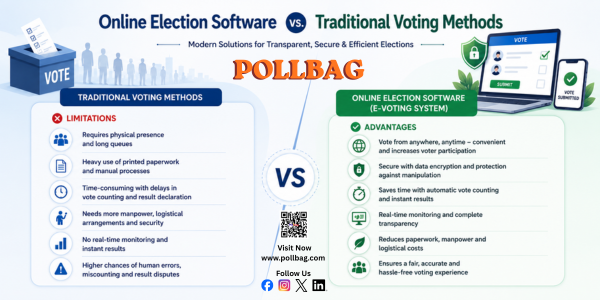
There are many advantages of E-voting in housing societies over the traditional paper voting system, as it is highly fast, convenient, transparent, and secure by all means. The reduced paperwork and administrative expense load is a good feature of using e-voting services. Earlier, the resolutions were passed by conducting paper elections, which were time-consuming and inconvenient to residents.

There are many advantages of E-voting in housing society:
1. Increased participation from residents depends on the convenience of voting from home or the workplace. Some may be busy with travel schedules and health problems, which is also a positive factor in the case of e-voting, as they can cast their vote through an online link without hassle. The convenience encourages more residents to do their duty to vote.
2. It is also useful for the residents who have the membership rights of the flat but are living in some other city due to their work commitments. Such residents can now participate in the housing society voting without physically visiting the society.
3. Trust is important in all election procedures, and the use of an online voting platform for RWAs is no exception. Automatic vote counting with authenticity is a salient feature of e-voting.
4. A security system is built here in the housing society election that allows only authorised members to vote for their candidates. A secure OTP verification and unique PIN restrict unauthorised use of the portal and prevent fake voting.
5. Time scarcity in the technology-driven world means that RWA residents always look for a fast voting process where e-voting takes place in a shorter duration and involves minimal human intervention. So, time efficiency is taken care of in the electronic form of elections for RWA societies.
6. Societies always have to run on limited budgets, so it is necessary to cut operational costs. Using online election software reduces expenses related to printing ballot papers and maintaining records. The entire process is shifted online to save money, time, and physical storage space.
7. Large residential societies have hundreds of residents who are on the voting list. Managing RWA elections in such a huge society is complicated and time-consuming. So, introducing e-voting for elections, approving maintenance decisions, and conducting internal surveys become easier with an electronic voting system.