Online Election Software vs Traditional Voting | Pollbag
Online Election Software vs. Traditional Voting Methods
Elections play an important role in decision-making and selecting the heads for different organisations, group housing societies, institutions, and corporate bodies. The voting process helps members to make a selection among various representatives or approve of resolutions. These are important decisions that shape an organisation or an association. Traditionally, the elections were conducted as ballot box elections. You are well aware of the physical voting procedure where printed papers were used with the candidates and their symbols on them for selecting the desired candidate.
However, with the change in technology and digital transformation, organisations today are moving towards electronic voting solutions. Both traditional voting methods and online e-voting serve the same purpose, but there is a great difference in terms of transparency, convenience, and security, as well as time efficiency. The modernisation of the election system in today's world has led to the conduct of smooth and transparent elections. So, online election software is becoming a preferred choice for RWAs and corporate governance bodies, too.
Limitations of the traditional voting system
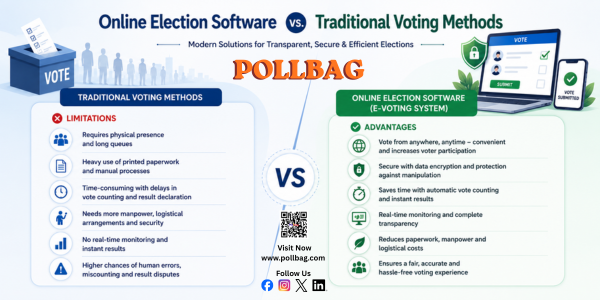
If we talk about the limitations of the traditional voting system, there are many. Managing a physical election required a lot of manpower, paperwork, additional time, and logistical arrangements. Sometimes, even the deadlines are passed due to unorganised election management and delays in manual processes.
If we talk about the biggest challenges of traditional voting methods in housing society elections, the dependency on physical presence, heavy usage of printed paperwork, and manual vote counting are the main ones. Sometimes, logistical planning like setting up polling booths, appointing election officers, and arranging for security to manage long voter queues affects the overall efficiency process of voting. Due to these challenges, a shift is seen towards online voting platforms for RWAs and organisations.
Lack of real-time monitoring and instant results generation can never be achieved when traditional voting methods are applied. Election authorities have to wait until all the ballots are counted manually before they can declare the final results. This process tends to take several hours or even days, depending on the size of the election, and sometimes deadlines also fail.
Advantages of Online Election Software and Secure E-Voting System Platform
The modern digital solutions, like online election software, help to overcome all the limitations cited above. They are used to simplify the election process and allow the voters to participate conveniently from any location. It reduces the barriers between the elections and the voters, so the participation rate increases for eligible voters, and it boosts the turnout.
Online election security eliminates potential manipulations with the help of data encryption and protection policies. This e-voting system adheres to mathematical and cryptographic methods in fundamental democratic principles. Elimination of manual vote counting can avoid result-distorting mistakes such as loss of voting documents or miscounted votes. Automatic vote counting leads to valid election results instantly at a mouse click.
Thus, the use of an online voting service has the highest level of transparency and control over the election process. It provides voters with a comfortable and secure voting experience. Also, it saves a lot of resources in planning the next election for the RWAs.